Read this before you let one go
How to join the relay
Nothing here is a rule. It's what tends to work, and what tends to happen, collected so you don't have to learn it by losing your favourite copy in week one.
Say it plainly, because it changes how you should treat the whole thing: this is a social experiment, not a delivery service. Nobody is guaranteeing the book arrives anywhere. You're releasing it to find out whether a stranger, with nothing to gain, keeps a small promise to an object that was never theirs.
First, the honest arithmetic
Most released books are never heard from again. Someone picks it up, loves it, and it lives on their shelf for the next decade. Sometimes it's binned by a cleaner. Sometimes it's read by four people who each meant to scan the code and each forgot.
Plan for a chain that stops at hop one or two. Release several books rather than one perfect one, and treat the silence as part of the shape of the thing. A book that goes quiet in Tbilisi is still a book that got to Tbilisi.
The books that travel furthest are almost never the ones you'd bet on.
Choosing the copy
- Thin paperbacks travel; hardbacks don't. Nobody carries 600 grams of somebody else's book across a border.
- Under 300 pages. A long book sits in a bag for months before it moves.
- Pick something finishable on a train. Short stories, essays and novellas outperform doorstops by a wide margin.
- Widely-read languages travel further, but a book in your own language, released locally, will do fine and often means more.
- Never release something you'd grieve. If the inscription from your grandmother is in it, photograph the inscription and release a different copy.
Choose your setup
All three get a book moving. Higher tiers just make it a few seconds easier for a stranger to check in, that's the whole difference, and you can mix them on the same book.
Bare minimum
Write it by hand
No printer, no plan needed. Open the front cover and write, in pen, the short link from
your confirmation email: booksrelay.com/b/CODE. Anyone who finds the book
can type that into any phone and land on its page. It costs nothing and works today.
Standard
Print the plate
A QR code, the same short link, and instructions in seven languages, generated the moment you register a book. Glue or tape it inside the cover, print a few spares, plates come unstuck.
Go further
Add an NFC tag
Stick a cheap NFC sticker in next to the plate, program it to open the link your QR uses, and tell your dashboard it's there. The plate then reads "tap or scan" instead of just "scan", and a tap works through a closed cover.
Downloads
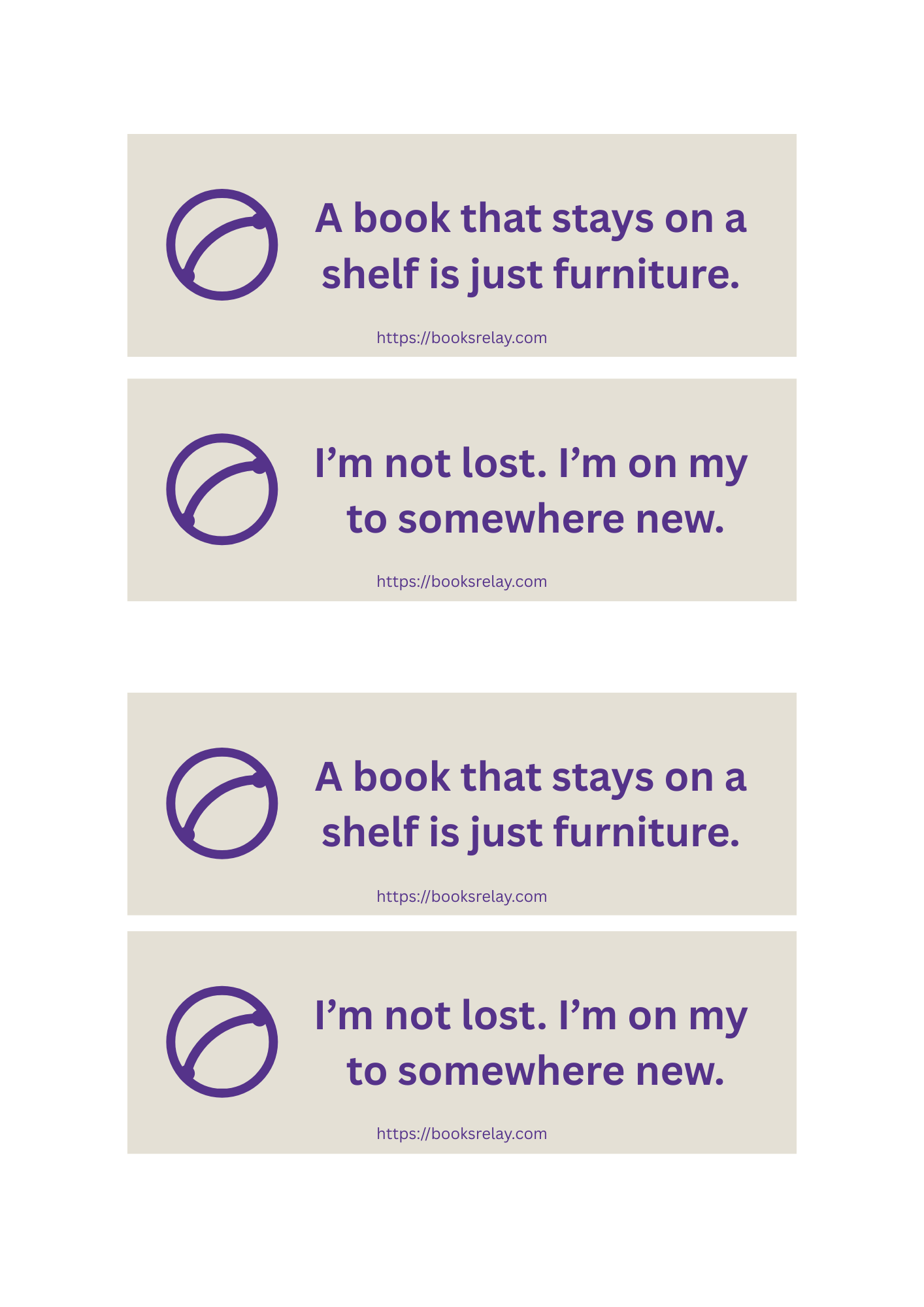
A blank plate to fill in by hand, or a bookmark to tuck inside instead of gluing anything down. Print, cut, done, no need to register a book first.
Printable bookmarks
Preparing the book
- Glue the plate inside the front cover. Tape at all four corners, or a glue stick across the whole back. Print three and tuck spares between pages, plates come unstuck. No printer? See "choose your setup" above, hand-writing the link works too.
- Add a blank signature page at the back. Write "name, city, date" at the top and leave the rest empty. The map is the public record; this becomes the object.
- Invite one underline. A line on the plate, "underline one sentence that got you", turns the book into a record of strangers' attention. After ten readers it's remarkable.
- Write the release note properly. It's the first thing a stranger reads and it decides whether they bother scanning. Five minutes, not thirty seconds.
Where to leave it
Roughly in order of how often the book is seen again:
- Hostel bookshelves. Backpacker culture already has a leave-one-take-one norm, and the people standing in front of that shelf are, by definition, in motion.
- Little Free Libraries and street book boxes. Registered, mapped, and used by people who already understand what a travelling book is.
- Hand it to someone flying out. The cheapest way to get real distance. A friend with a boarding pass beats any park bench.
- Long-distance trains and buses. Seat pocket, on the way off. Overnight routes are best, people are bored and looking for something to hold.
- Cafés with shelves, laundrettes, university common rooms, waiting areas.
Weak spots: park benches in bad weather, anywhere with an efficient cleaning crew, and the bottom of any pile.
A word on leaving objects around
Don't leave unattended packages in airports, stations, or anywhere with visible security. In many cities that's a genuine problem rather than a whimsical one, and it will end with the book in a bin at best. Shelves, tables and counters read as "left for someone". Floors and corners don't. If a place has staff, ask them, most shopkeepers say yes and half of them get interested.
Writing the release note
The note is the whole difference between a tracked object and a story. Say where the copy came from, who gave it to you, and what it did to you. Be specific and a little too honest. Avoid summarising the plot, they're holding the book.
Template · the release note
Template · handing it to a stranger
Template · a note for a hostel or café shelf
Template · a message to the next reader, left by a reader
Asking for it back
You can set a book to ask, after a certain number of hops, whether whoever's holding it would post it home. Three things to know: it's a request and never enforced; the address stays hidden until the book actually reaches that point, and is shown only to the person holding it; and international postage often costs more than the book, so offer to cover it.
Consider not asking. A book that comes home is a nice ending. A book still moving in nine years is a better one.
Privacy, plainly
- Check-in coordinates are rounded to about a kilometre before they're stored. The precise pin never touches the database.
- Uploaded photos are re-encoded on arrival, which discards all embedded camera data including GPS.
- Names are optional at every step. Plenty of the best notes are unsigned.
- Owner email addresses are never shown publicly.
- You get an email every time your book is checked in, and you can hide or delete anything on your book's page.
What people usually get wrong
- Releasing one book and waiting. Release five. The variance is enormous.
- Checking the page hourly for a week. The good check-ins arrive at month seven.
- Leaving it somewhere too clever. Obvious beats poetic. A shelf beats a statue.
- Writing a plot summary instead of a reason. Nobody scans a code for a blurb.
- Only releasing books they didn't like. It shows, and nobody carries a dull book across a continent.
Follow along
Every book here is its own thread, but if you'd rather see the shape of the whole experiment, check-ins and journeys as they land, rather than one copy at a time, that's what @booksrelay is for.